The Digital Museum
Why virtual museums are more than digital copies – and how immersion makes culture newly experienceable.
Why Virtual Museums Are More Than Digital Copies
Museums thrive not only on their exhibits, but above all on the atmosphere they create. Walking through historic rooms, the feeling of being up close to an artefact, and the opportunity to discover details from a new perspective make a museum visit a special experience. This is exactly where virtual reality comes in: VR is far more than a classic 2D online tour. It creates immersion - the feeling of actually being there.
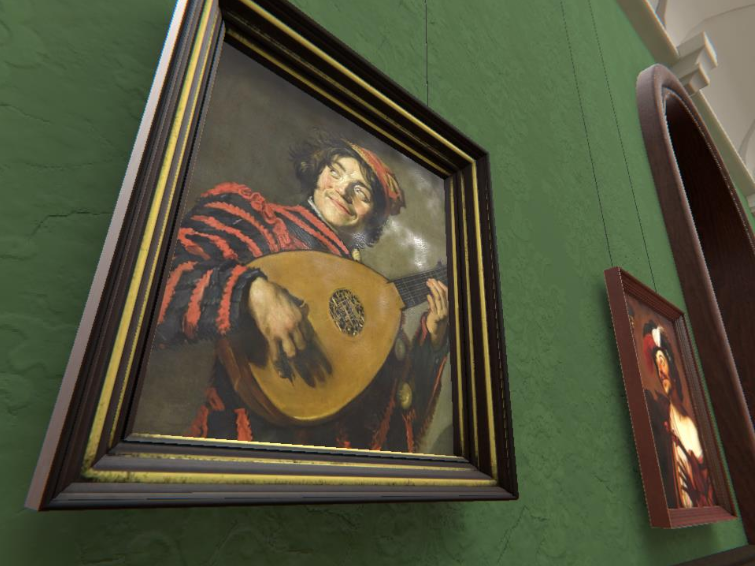
As more and more museums digitise their collections, the importance of digital archives and virtual exhibitions is also growing. Our digital museum deliberately goes one step further: instead of a purely online gallery, a vibrant virtual space is created with photorealistic environments, high-resolution 3D models, and interactive experiences.
Digital Museums in General
The idea of a virtual museum experience is being implemented more and more frequently. The London National Gallery uses various XR technologies as part of its "Virtual Gallery" initiative and the National Gallery X (NGX) innovation lab to make artworks digitally experienceable. Its launch in March 2025 Imaginarium is a browser-based space that combines soundscapes and animations.
Despite the multisensory experience, the Imaginarium is not truly immersive: it does not use digital twins of the real museum objects - instead, only animated scenes are embedded in the virtual space. The special effects are often perceived as disruptive because the original objects are not fully and faithfully reproduced.
Purely Virtual Museums
In contrast to real museums with virtual applications, there are various purely virtual museums whose exhibitions would often be physically impossible to realise in the real world:
- Museum of Other Realities (MOR) a purely virtual art gallery for contemporary VR art, developed specifically for VR headsets.
- Kremer Museum VR collection of Flemish and Dutch paintings in a futuristic, virtual architecture.
- VR Space Museum Cosmoria focused on space and astronomy with interactive exhibits in a digital environment.
- VR Museum of Fine Art world-famous sculptures and paintings in their original size via VR simulation.
- OmniGallery virtual gallery for digital, contemporary art.
- National Women's History Museum has existed for years almost exclusively in the digital space.
Museum Apps
In addition to digital museums, apps are a useful tool for enhancing museum experiences: Google Arts & Culture offers 360-degree tours through hundreds of museums and artworks in very high resolution. Smartify identifies paintings and sculptures via smartphone camera and provides detailed information. MuseumStars allows users to collect points and level up in over 100 museums. Many museums also offer their own apps for on-site audio guides.
Technical Implementation
An exciting example is The Digital Museum: a browser-based application developed with Unity WebGL that makes high-resolution 3D models, scientific data, and artworks accessible in an immersive environment.
Through Unity's Addressable System large amounts of data can be efficiently loaded and unloaded - crucial for high-performance web applications with complex 3D content. Objects that are neither visible nor audible are removed from memory. This keeps the application performant at all times and virtually infinitely extensible.
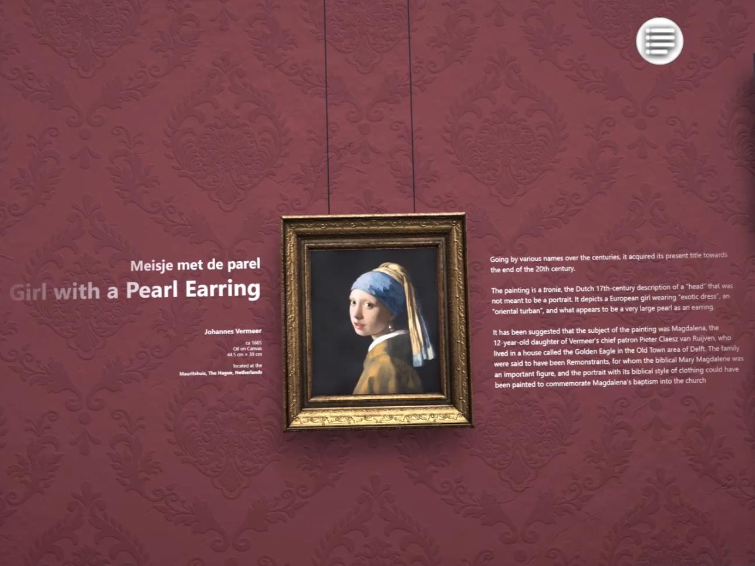
High-resolution textures are compressed into ktx2 containers packaged in a modern GPU-friendly data format. Paintings can thus be displayed in 8K resolution, tiny details are preserved, and visitors can literally get up close to the works.
The Digital Museum is based on the XRwise Cross-Reality Platform and enables flexible design of immersive exhibition spaces. By linking physical and virtual spaces, new hybrid presentation formats are created that can be experienced live together with many others. Content can be adapted, updated, or re-curated without any programming effort.